



BuddyBoss vs Circle is not really a question of which platform has more community features.
Both can support serious paid communities.
The bigger difference is how you want the business behind that community to operate.
Circle gives you a hosted environment where community, courses, events, memberships, payments, and other business tools can live inside one platform. BuddyBoss takes a different approach: your community lives inside WordPress, where you can connect it more deeply with an LMS, membership system, WooCommerce, custom functionality, and the rest of your website.
That distinction matters more than a feature checklist.
If the priority is getting a polished paid community running quickly with fewer technical responsibilities, Circle can make a lot of sense.
If the community needs to become part of a wider WordPress system with custom learning, membership, commerce, or access requirements, BuddyBoss gives you much more architectural control.
This is how I would evaluate the decision.
BuddyBoss vs Circle: The Short Answer
I would usually look at the decision this way:
Choose Circle when the business wants the community platform itself to handle most of the operating model.
That can include discussions, courses, events, paid memberships, subscriptions, payments, member profiles, reporting, and other engagement tools without having to assemble a separate WordPress stack. Circle currently positions these capabilities as part of its integrated community platform.
Choose BuddyBoss when the community needs to become part of a broader WordPress architecture.
That is where the ability to combine community functionality with systems such as LearnDash, membership plugins, WooCommerce, WordPress roles, and custom functionality becomes more valuable. BuddyBoss currently supports access controls based on membership levels and integrations including MemberPress, Paid Memberships Pro, WooCommerce Memberships and LearnDash Groups/Memberships.
Neither operating model is automatically better.
The question is whether the business benefits more from consolidation and convenience or control and flexibility.
The Biggest Difference Is Not the Community Features
At first glance, BuddyBoss and Circle overlap quite heavily.
Both can give members a place to interact.
Both can support groups or structured spaces.
Both can be part of a paid membership business.
Both can support learning experiences.
That makes it tempting to compare them row by row.
I do not think that is the most useful way to make this decision.
The more important question is:
Where does the community sit inside the rest of the business?
If the community is most of the product, Circle’s consolidated model becomes attractive.
If the community is one part of a larger WordPress ecosystem containing courses, memberships, ecommerce, custom access rules, company training, private groups, or other business systems, BuddyBoss becomes a very different proposition.
That is why architecture matters.
Circle Is a More Consolidated Operating Model
Circle is designed to keep a large part of the community business inside one hosted platform.
Its current platform includes discussions, courses, events, live experiences, paid memberships, a website builder, reporting, member profiles, gamification, payments and access controls. Its higher plans add workflows, APIs, custom profile fields and other business functionality.
For many businesses, that is a major advantage.
You are not deciding which WordPress plugin should own memberships.
You are not selecting a separate LMS simply because you need courses.
You are not maintaining the server that runs the community.
You have fewer moving parts.
That can make Circle particularly attractive for:
- Coaches running memberships,
- Creators selling courses and community access,
- Professional communities,
- Membership businesses with relatively straightforward access models,
- Teams that want to avoid managing technical infrastructure
Circle also supports one-time purchases, subscriptions and membership-based monetization for learning communities, so it should not be treated as simply a discussion platform.
That is important because older comparisons sometimes describe Circle as if it were only the lightweight alternative.
It is much more capable than that now.
BuddyBoss Gives You More Control Over the Wider Platform
BuddyBoss becomes interesting for a different reason.
You are building the community inside WordPress.
That means the community does not have to exist as a largely self-contained platform.
It can become part of a broader system.
For example, the same business might have:
- LearnDash for courses, progression, quizzes, and learner reporting
- MemberPress for recurring memberships and entitlement rules
- WooCommerce for products, checkout, and transactions
- BuddyBoss for profiles, groups, activity, messaging, and community interaction
- Custom WordPress functionality for business-specific workflows and integrations
That architecture is more complicated.
But sometimes the complexity exists because the business itself is more complicated.
If that describes the platform you are planning, I would not select BuddyBoss based only on its community interface. I would first map the LMS and community architecture so it is clear which system should own each responsibility.
That matters because WordPress flexibility is useful only when the platform is structured properly.
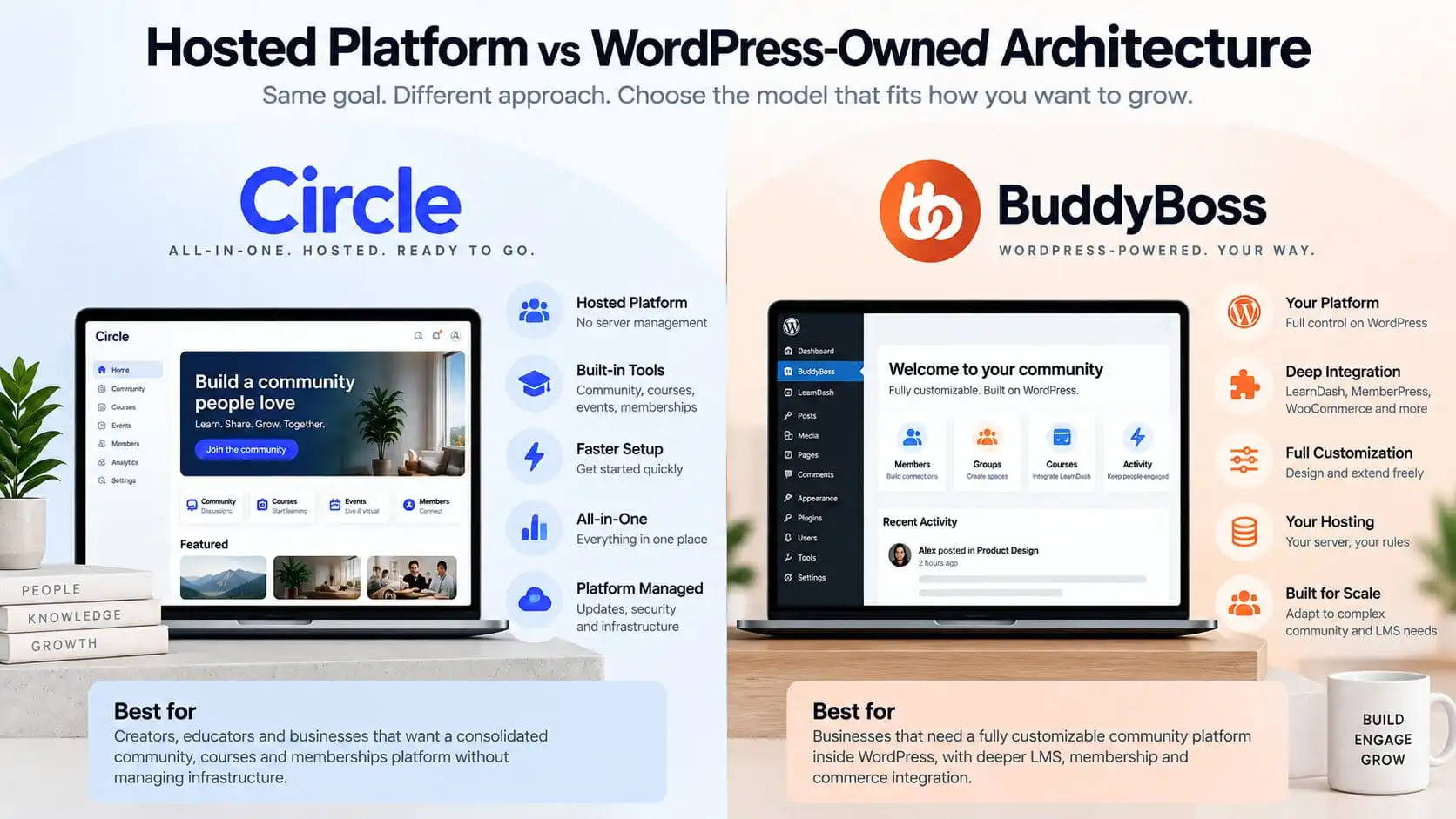
Hosted Platform vs WordPress-Owned Architecture
The trade-off can be summarized quite simply.
Circle removes a significant amount of infrastructure responsibility.
BuddyBoss gives you greater control over the infrastructure and architecture.
With Circle, hosting and the core application are managed as part of the service.
With BuddyBoss, you control the WordPress environment, which also means hosting, updates, performance, backups, security and compatibility need to be managed properly.
That sounds like an argument for Circle until the business requires something Circle’s operating model was not designed to control.
Then the ability to work directly with WordPress, its database, plugins, APIs and custom functionality can become a significant advantage.
So I would not ask:
Which platform requires less work?
I would ask:
Which responsibilities does the business actually need to control?
Which Is Better for Courses and Learning Communities?
This is one of the areas where the decision becomes more interesting.
Circle now includes its own course functionality and positions courses, community, events, engagement and monetization as one connected system. It supports self-paced and cohort-style learning, live sessions, comments, messaging, gamification and paid access within the same platform.
For a business selling courses with community around them, that may be enough.
You may not need WordPress or a separate LMS at all.
BuddyBoss makes more sense when the learning architecture itself is more demanding.
For example:
- A training company may require LearnDash Groups for corporate clients.
- A certification platform may need more complex quizzes, reporting, or progression.
- A membership business may need one tier to unlock several courses plus specific community groups.
- An established business may already have years of LearnDash content, users, and progress data that it does not want to migrate.
In those situations, BuddyBoss does not need to replace the LMS.
It can become the community layer around the LMS.
If LearnDash is part of the platform, the more important question is usually not whether BuddyBoss can connect to it, but which system should control learning, community, memberships and access. I covered that structure in LearnDash + BuddyBoss: How the Architecture Should Actually Work.
That distinction is one of the strongest reasons to consider BuddyBoss for a serious learning business.
Which Is Better for Paid Memberships?
Circle makes paid memberships relatively straightforward because monetization, subscriptions and access control are built into the same environment.
It supports paid memberships, subscriptions, one-time purchases and gated access to combinations of community spaces and content.
For a straightforward membership business, this consolidation can be very attractive.
BuddyBoss itself is usually only one part of the membership architecture.
You may use MemberPress, Paid Memberships Pro, WooCommerce Memberships or another system to control the commercial membership lifecycle while BuddyBoss handles the community experience.
That can support more complicated models, but it introduces a question that every WordPress membership build should answer:
Which system is the source of truth for access?
If MemberPress says the membership has expired but another integration leaves the member inside a BuddyBoss group, you have an access problem.
If WooCommerce controls one product, LearnDash controls course enrolment and BuddyBoss groups are being assigned independently, you can easily end up with overlapping rules.
If membership status controls access to both courses and community areas, it is worth deciding whether a separate membership layer is actually necessary. I covered that decision in Do You Actually Need MemberPress With LearnDash?.
This is one of the areas where flexibility needs discipline.
Ownership and Platform Dependence
This comparison needs some nuance.
It would be inaccurate to say that Circle customers do not own their community data. Circle explicitly states that customers own their community, content and member data.
The more meaningful distinction is platform control.
With Circle, your business operates inside Circle’s hosted product.
Circle decides how the core platform evolves, which features are available at each plan level, how the application itself is operated and which forms of customization are supported.
With BuddyBoss, the application lives inside your WordPress environment.
That gives you more control over the wider implementation.
You can change hosting.
You can develop custom plugins.
You can connect additional WordPress systems.
You can directly influence how data and workflows are structured.
You can replace pieces of the stack without necessarily replacing the entire platform.
That control is valuable when there is a business reason to use it.
If there is not, it can simply become more infrastructure to manage.
Customization and Custom Business Workflows
This is where I would expect the difference to become much more noticeable on sophisticated projects.
Circle does provide customization, branding, APIs and workflow capabilities, especially on its higher plans. The Business plan currently includes workflows, custom profile fields, a Headless Member API and an Admin API.
So it would be wrong to describe Circle as inflexible.
The difference is that customization still happens within the boundaries of the Circle platform.
WordPress gives developers a much broader environment to change the underlying experience.
With BuddyBoss, a business can potentially build custom logic around:
- Membership entitlements
- Company accounts
- User roles
- Custom dashboards
- Course access
- Private client areas
- WooCommerce purchases
- Custom profile data
- External APIs
- Reporting
- Business-specific automations
That does not mean every BuddyBoss project should be heavily customized.
Quite the opposite.
The best platforms usually customize only what creates real business value.
But when custom workflows are genuinely part of the requirement, BuddyBoss gives you more room to build them.
For projects where BuddyBoss needs to become part of a larger commercial system rather than just a standalone community, this is exactly the kind of work covered by my BuddyBoss development services.
Maintenance and Technical Responsibility
This is one area where Circle has a clear structural advantage.
You do not operate the underlying application stack.
That means the business does not need to manage WordPress core updates, plugin compatibility, PHP versions, caching layers, database optimization or server-level performance just to keep the community running.
With BuddyBoss, those responsibilities still exist.
The fact that WordPress gives you more control also means somebody needs to manage that control properly.
This becomes increasingly important as the community grows because logged-in community traffic behaves differently from a mostly public marketing website.
Activity feeds, messages, notifications, user queries, groups, memberships and LMS activity can all create dynamic workloads that cannot simply be solved by putting a full-page cache in front of everything.
So when comparing operating costs, do not compare only:
Circle subscription vs BuddyBoss licence.
Compare:
the total cost of operating each model.
For Circle, that is primarily platform subscription plus any other external tools you still need.
For BuddyBoss, it can include hosting, plugin licences, maintenance, development support, performance work and integrations.
That may still be the better investment for a business that benefits from the additional control.
But it should be a deliberate decision.
What Happens When the Business Becomes More Complex?
This is the question I would think about before choosing either platform.
Imagine the business starts simple.
- Corporate customers
- Different learning paths
- Separate community access by client
- Multiple membership tiers
- WooCommerce products
- Company managers
- Custom reporting
- Private cohorts
- Automated enrolment
- External integrations
You do not need all of those features on day one.
But you should understand whether the likely direction of the business fits the platform you are choosing.
Circle’s strength is that it keeps a lot of the operating model consolidated.
BuddyBoss’s strength is that WordPress lets the architecture expand in more directions.
One is not automatically more scalable than the other.
They simply scale differently.
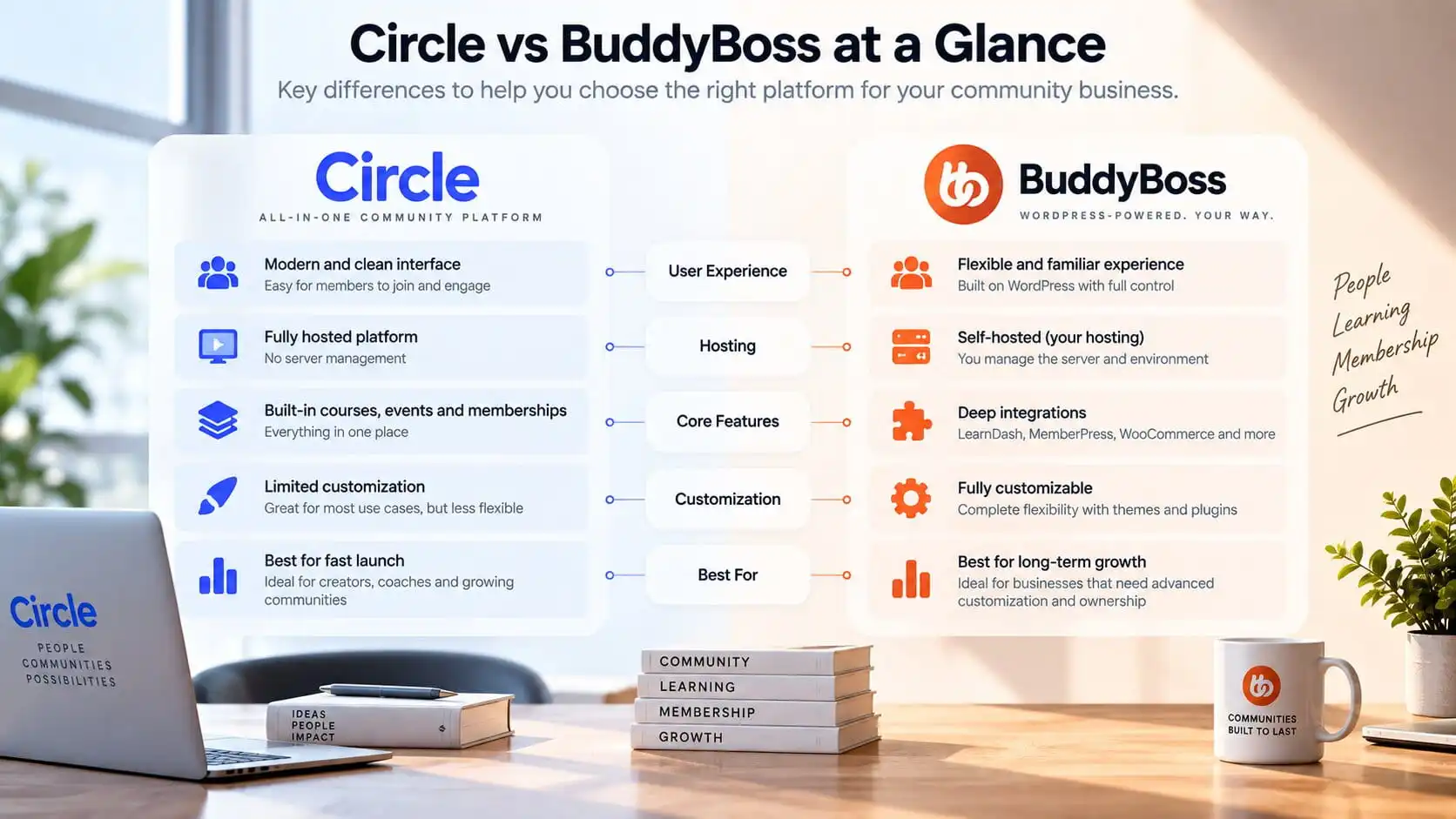
Circle vs BuddyBoss at a Glance
I would interpret the comparison this way:
Circle reduces the number of technical systems you need to assemble yourself.
BuddyBoss increases the number of things you can control.
That is why I would not choose BuddyBoss simply because the business wants more flexibility.
Flexibility has a cost.
Someone has to design the architecture, maintain the integrations and keep the platform reliable.
And I would not choose Circle simply because it is easier to launch.
Convenience also has a trade-off.
The business has to be comfortable operating within the capabilities and boundaries of the hosted platform.
The better question is:
Which trade-off matches the way this business expects to operate over the next few years?
When I Would Choose Circle
I would seriously consider Circle when the business wants to get a professional paid community running without owning a large technical stack.
It is particularly attractive when courses, memberships, events and community can all live comfortably inside the same platform.
I would lean toward Circle when:
- The community is the primary product.
- The team wants fewer technical responsibilities.
- Launch speed matters.
- The membership model is reasonably straightforward.
- Circle’s built-in course functionality is sufficient.
- There is no strong requirement for deep WordPress customization.
In those cases, using WordPress simply because it offers more flexibility may create work the business does not actually need.
When I Would Choose BuddyBoss
I would lean toward BuddyBoss when the community needs to become part of a broader WordPress business system.
That usually means something else is important besides community alone.
For example:
- LearnDash already powers a serious LMS.
- MemberPress or another membership system controls wider site access.
- WooCommerce is central to the commercial model.
- The business requires custom access or account logic.
- Existing WordPress content, users, and systems need to remain in place.
- Custom development is required beyond what a hosted platform exposes.
- The business wants deeper control over how the overall platform evolves.
BuddyBoss has also continued adding tools intended to reduce setup friction. Its ReadyLaunch feature, for example, provides a pre-styled community layout so not every new site needs a completely custom community design before launch.
So choosing BuddyBoss does not necessarily mean everything needs to be custom-built.
It means the option is there when the business actually needs it.
Do Not Choose Based on the Longest Feature List
This is where most platform comparisons go wrong.
A feature matrix can tell you whether a platform has discussions, courses, events or memberships.
It cannot tell you whether the architecture fits the business.
That requires understanding:
- What is being sold
- Who gets access
- What happens when someone upgrades
- What happens when a payment fails
- Where course progress lives
- Whether companies or teams need separate access
- How the community connects to learning
- What needs to be reported
- How much technical responsibility the business actually wants
Those questions are much more useful than asking which platform has one extra feature today.
Features change.
The operating model is harder to change once hundreds or thousands of members depend on it.
Final Decision: Choose the Operating Model, Not the Feature List
For a straightforward paid community that values a fast launch, integrated tools and lower infrastructure responsibility, Circle can be a very sensible choice.
For a business where community needs to integrate deeply with WordPress, LearnDash, memberships, WooCommerce or custom workflows, BuddyBoss can provide the additional architectural control that the project needs.
The important part is knowing why you are choosing one.
Do not choose BuddyBoss because WordPress gives you endless possibilities if the business will never use those possibilities.
And do not choose Circle purely because it is easier to operate if you already know the business requires deeper LMS, membership or custom workflow integration.
Before committing to either platform, map the business model first:
Payment → Membership → Access → Learning → Community → Renewal / Expiry
Once that flow is clear, the platform decision usually becomes much easier.
If you are planning a paid LMS or community platform and are unsure whether BuddyBoss, Circle, or another architecture fits the business, I can help map the LMS, membership and community architecture before development begins.